Saturday, February 11, 2012

Saturday, January 28, 2012
Authentic Learning Group Diigo (weekly)
These “recipe cards” for Project/Problem Based Learning are intended for teachers to use with K12 students in groups, as well as individual students.Each card creates student learning categorized as TimeTravelers, Artists & Inventors, Historian Challenges, StoryTellers, ProblemSolvers, Scientist Challenges, Career & Tech Ed.The cards are meant to help teachers integrate core content and deeply embed creativity, problem-solving, and collaborative learning in each student, with or without the use of technology tools.The core content pieces are the basic ingredients with which teachers can cook delicious content for their hungry learners.Teachers are able to customize the driving questions in each of the content areas to fit the unique needs of their learners. The cards guide teachers through the basic steps of the project, with ideas and suggestions for best practice.The tips & tricks help establish a safe and respectful learning environment every single day of the year.
- - By Ginger TPLC
Posted from Diigo. The rest of Authentic Learning group favorite links are here.
Friday, January 27, 2012
Friday Links of Note
Friday Links of Note
-
Ten Things You're Not Allowed to Say at Davos - Umair Haque - Harvard Business Review
I think many of the bullet points that Haque applies to Davos are applicable to all the conferences that educators occupy themselves with. I especially think the one about 'insiders rarely topple the status quo' is dead on. If you have time to go to these self-congratulatory fetes, then you are probably part of the powers that be. I could change my mind on this.
- Talk is cheap (and the more talk there is, the cheaper it gets). Corporations booking record profits as cities, states, and countries go broke have little (read: zero) incentive to actually do much get people, communities, and society out of this mess. The most powerful and influential folks at Davos — the titans of the global economy — probably won't do anything to heal the world, for the simple reason that because, as things stand, they "profit" most from its suffering. Want fries with that unsafe drinking water, bottom billion?
- You can't solve a problem on the level it was created (as Einstein's reputed to have said). This great crisis is in our economy — and so it might be of our society, culture, and polity.
- Insiders rarely topple the status quo.
- Moral vacuums tend to empower the amoral. Self-explanatory: take a look at these accounts of bankers vigorously defending what at this point my pet hamster knows is basically indefensible. It's like a self-parody — except it's not. Economists aren't exactly renowned for having a moral compass, yet without one, it's impossible to take on the fundamentally ethical challenge of rebooting prosperity.
- You need a whole brain to be a human. 21st century intelligence is not just analytical — it's ethical, emotional, and creative.
-
-
Addictive UX: Why Pinterest Is So Dang Amazing | Design Shack
Why we love Pinterest. And I do love it. I am looking for a spinach recipe right now from there. I am planning on demonstrating to my students what a Google 20% project might consist of for our Intro to College Writing Class next week. This article will be my framework for that.
-
Best Education Books of 2011 - The Huffington Post
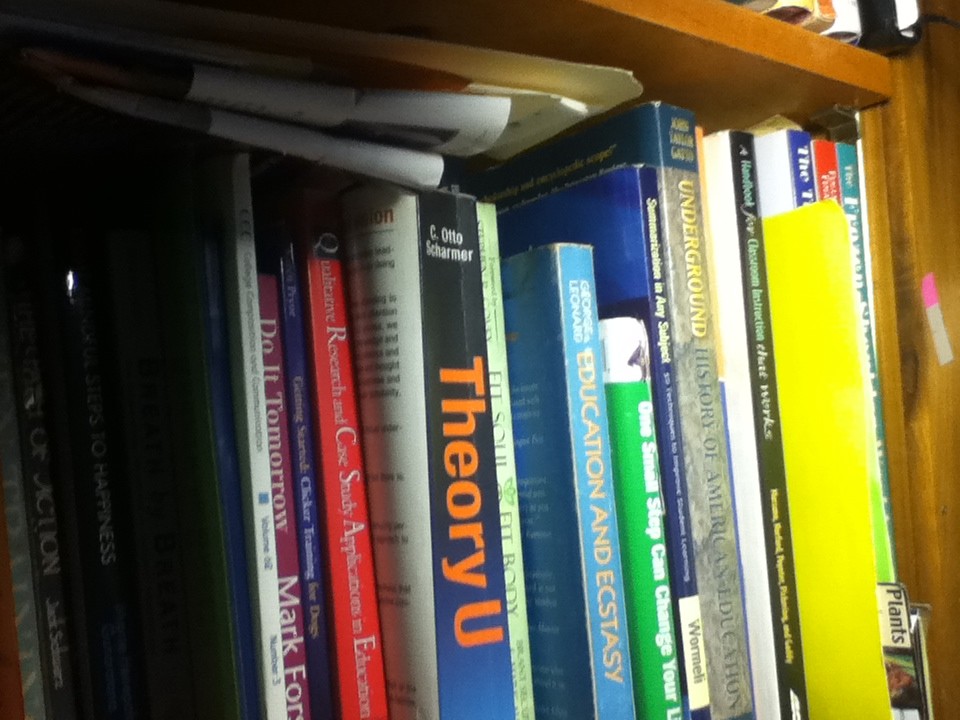
Stager is an interesting character/curmudgeon and this is a worthy short list. No nonsense. Real teachers and real learning. Any one of these books could set a match to the tinder that is K-12 public and private education in this country.
- This article does more than suggest that you have an alternative to a CV or a resume, it also suggests that you live a completely different professional life, one dominated by demonstrable 'doing'. This means that project-based constructivist-connectivist learning will have to take the lead from K-20 and beyond.
-
With Udacity, Former Stanford Professor Goes All-In on Online Learning - Education - GOOD
There is a different mode of learning afoot. It is what Howard Rheingold calls peeragogy. Combine participatory, peer-based learning with super-large online course taught by real practitioners (Udacity) and you will begin to see the glimmerings of a new type of learning that is both formal and informal. It is a new way -
Audiobooks.com lets you fill your ears for $25 per month | VentureBeat
-
A Way To Think About Online Courses (By Apple, For Example) | Easily Distracted
Etextbooks are rising in the edu-zeitgeist. Steve Jobs' last legacy was a desire to totally disrupt the textbook market with electronic texts. This article looks beyond the hype of Apple's recent media blitz, but more importantly points to the possibility that etextbooks might not be recognizeable as textbooks at all. Etextbooks might mark the end of the idea of textbooks.
Saturday, January 21, 2012
Authentic Learning Group Diigo (weekly)
Thursday, January 12, 2012
Sunday, January 08, 2012
Newspeak Reminders from "A Word a Day"
From: Henry Willis (hmw ssdslaw.com)
Subject: Newspeak and Papier Deutsch
Before the Bush Administration gave us the phrase "enhanced interrogation" another administration used "collateral damage" to refer to the killing of civilians -- who had, by some process of word magic, lost their identity as humans to become merely "damage", like a broken window or a fallen tree. The Nazis did the same thing on a far more barbaric scale with terms such as die Endlösung, which turned mass murder into a bloodless impersonal noun.
This is not just another example of the bureaucratic degradation of language, although that is certainly part of it. As Orwell said in his great essay on politics and the English language:
"In our time, political speech and writing are largely the defense of the indefensible.... Thus political language has to consist largely of euphemism, question-begging, and sheer cloudy vagueness.... Such phraseology is needed if one wants to name things without calling up mental pictures of them."
Or if you want to go back further, then we can quote the words that Tacitus put in the mouth of the Celtic chieftain Galgacus:
"To robbery, slaughter, plunder, they give the lying name of empire; they make a desert and call it peace."
Henry Willis, Los Angeles, California
Subject: Newspeak and Papier Deutsch
Before the Bush Administration gave us the phrase "enhanced interrogation" another administration used "collateral damage" to refer to the killing of civilians -- who had, by some process of word magic, lost their identity as humans to become merely "damage", like a broken window or a fallen tree. The Nazis did the same thing on a far more barbaric scale with terms such as die Endlösung, which turned mass murder into a bloodless impersonal noun.
This is not just another example of the bureaucratic degradation of language, although that is certainly part of it. As Orwell said in his great essay on politics and the English language:
"In our time, political speech and writing are largely the defense of the indefensible.... Thus political language has to consist largely of euphemism, question-begging, and sheer cloudy vagueness.... Such phraseology is needed if one wants to name things without calling up mental pictures of them."
Or if you want to go back further, then we can quote the words that Tacitus put in the mouth of the Celtic chieftain Galgacus:
"To robbery, slaughter, plunder, they give the lying name of empire; they make a desert and call it peace."
Henry Willis, Los Angeles, California
Saturday, January 07, 2012
Saturday, December 10, 2011
Authentic Learning Group Diigo (weekly)
Lessons from a Public School Turnaround | Edutopia
Once the eighth lowest-performing middle school in the state, Cochrane Collegiate reversed course and is swiftly raising student achievement by investing in research-based teaching strategies, enhancing teacher excellence, and fostering strong relationships. Read the article. [Interactive Video Player: Look for downloadable PDF worksheets and other resource links to appear under the player as you watch the video.]
- - By edutopia .org
Posted from Diigo. The rest of Authentic Learning group favorite links are here.
Saturday, December 03, 2011
Authentic Learning Group Diigo (weekly)
To accommodate differences, Vocabulary and SpellingCity had added several lists of British spelling words and their corresponding US words.
- - By Cara Whitehead
Posted from Diigo. The rest of Authentic Learning group favorite links are here.
Saturday, October 08, 2011
Saturday, October 01, 2011
Authentic Learning Group Diigo (weekly)
Never grade another spelling test again! Let SpellingCity do it for you!
- - By Cara Whitehead
Posted from Diigo. The rest of Authentic Learning group favorite links are here.
Thursday, September 29, 2011


Saturday, September 24, 2011
Authentic Learning Group Diigo (weekly)
Free, fun online practice for homophones
- - By Cara Whitehead
Posted from Diigo. The rest of Authentic Learning group favorite links are here.
Saturday, September 17, 2011
Authentic Learning Group Diigo (weekly)
Free online games and printable resources
- - By Cara Whitehead
Posted from Diigo. The rest of Authentic Learning group favorite links are here.
Saturday, September 10, 2011
Authentic Learning Group Diigo (weekly)
The Role of Mistakes in the Classroom | Edutopia
Journalist Alina Tugend finds that mistakes in the classroom should not only be tolerated, but encouraged.
- - By edutopia .org
Posted from Diigo. The rest of Authentic Learning group favorite links are here.
Monday, September 05, 2011
Textbooks Are Killing Me!
Things I Know 217 of 365: Textbooks are killing me at Autodizactic
There is a constant struggle as a student to afford school while at the same time all around him teachers and textbook publishers seem to conspire against the simple motive of saving money. Zac Chase of Autodizactic has a nice workflow for being a frugal triumphalist in the battle against the 'man'.
- I downloaded Amazon’s student app and used it in the COOP to scan course texts for their Amazon.com partners. Where the Amazon texts were less expensive, I added them to my cart. (This was the case in all but two instances.)
- When I got home, I compared the items in my Amazon cart with used versions available through amazon. Whenever possible, I chose the used version.
- I took advantage of amazon’s offer of 6 months of free Amazon Prime membership for students. This secures free 2-day shipping and other as of yet unknown “deals.” (When selecting used texts, I only purchased those qualifying for Amazon Prime.)
- When it was possible, I purchased the Kindle version of texts. I’ll be reading them on my iPad, but I’d take advantage of the new Kindle Cloud feature if I didn’t have a Kindle or iPad.
- I opted against texts that were recommended but not required (with the exception of the APA style guide).
I’ve been thinking of how we might shape a new model of for texts that might lower the materials cost of higher education and thereby make it more accessible who find it cost prohibitive. Certainly, I realize tuition far out-paces course materials as an item on students’ higher ed budgets. Still, every bit helps.
Some steps I took:
As a result, my possible costs of $600 ended up at around $450. That’s a chunk of rent or more than a month’s worth of groceries.
Give it a try next semester and then lobby your friendly, neighborhood academic departments to work with students to help in every way they can.
What's the Fuss with Google "Suggested Users"
She also points out that
Google’s Bradley Horowitz — de-facto spokesperson for the new list — does recognize that there isn’t an “extreme knitters” group. In a post yesterday, he says he wants to assure extreme knitters — along with everyone else who isn’t a tech or pop culture celebrity — that the fact that Google doesn’t recognize your interest group is “a bug.”
Saturday, September 03, 2011
Authentic Learning Group Diigo (weekly)
Free educational games and songs games for kids
- - By Cara Whitehead
Posted from Diigo. The rest of Authentic Learning group favorite links are here.
Saturday, August 27, 2011
Authentic Learning Group Diigo (weekly)
- - By Cara Whitehead
- Contractions are formed when two words are contracted or put together and an apostrophe is added to replace the omitted letters.
- Contractions are formed when two words are contracted or put together
- Contractions are formed when two words are contracted or put together
- together
- Contractions are formed when two words are contracted or put
- Contractions are formed when two words are contracted or put
- Contractions are formed when two words are contracted or put
- Contractions are formed when two words are contracted or put
- put
- Contractions are formed when two words are contracted or put
- Contractions are formed when two words are contracted or put
- Contractions
- are formed
- Contractions
Word Lists
Analogies - New!
Capitonyms
Compound Words - New!Contractions
Dolch - Sight Words
Geography Lists
Homophones, Homonyms, etc.
Literature Based Word Lists
Math Vocabulary - Most Popular!
Monthly Holiday Lists
Multiple Meaning Words - New!
Phonics & Sight Word Curriculum
Possessive Nouns
Sample Lists By Grade
Science Vocabulary - New!
Sequential Spelling Program
Sound Alike Words
Syllables - New!
Word AbbreviationsHelp and Information
FAQs - Frequently Asked Questions
Printables
Our Educational Awards
Testmonials- New!when two wordsare contracted orare contractedare contracted or putare contracted or putContractionsContractionsContractionsare contracted or putContractionsContractionsContractionsWord Lists
Analogies - New!
Capitonyms
Compound Words - New!Contractions
Dolch - Sight Words
Geography Lists
Homophones, Homonyms, etc.
Literature Based Word Lists
Math Vocabulary - Most Popular!
Monthly Holiday Lists
Multiple Meaning Words - New!
Phonics & Sight Word Curriculum
Possessive Nouns
Sample Lists By Grade
Science Vocabulary - New!
Sequential Spelling Program
Sound Alike Words
Syllables - New!
Word AbbreviationsHelp and Information
FAQs - Frequently Asked Questions
PrintablestractionsContractionContractionsContractionsareare contracted or putContractionsare formedwhen two words are contracted or puttogetherare contracted or puttogetherareare contracted or putContractionsare formedwhen two words are contracted or puttogetherare contracted orare contractedare contractedare contracted orare contracted orarearecontracted orare contracted orare contracted orare contractedare contractedare contracted orare contractedwhen two words are contracted or put
Posted from Diigo. The rest of Authentic Learning group favorite links are here.Subscribe to: Posts (Atom)