Sunday, February 27, 2011

Notes for Summary

Sociology 510

Dr. Steve Groce

Terry Elliott

3/2/2011

Liebow echoes Jyndon Johnson's 'war on poverty' as unfortunate a metaphor as has ever been promoted.

Fast forward from past to present--poverty has always been with us, in 1963 25% poor, 30% black. The Black Poor are more extreme and tend to be generational.

A paucity of studies on male poverty as opposed to female and children.

Black male is written off as beyond help and as needing to help himself. NO research necessary.

Black male is 'harder to reach'--one might say that there are fewer leverage points on him-no children or mothers of children to act as a place to pry forth research information.

And like the carpenter every problem looks like a nail, every black problem tends to look like the problems of children and mothers.

The black subjects tha can be studied are 'captive' and thus the sample is skewed toward that bias.

Upshot? Expand range of research into to lower-class life. But there are problems including the validity of interview and questionnaire techniques.Gr8 response in fokotnote on 4 on page 9 that points to the problem of assuming that responses to questionaires and surveys mean the same thing to lower and middle class folks.

Purpose of study? Coming to 'grouind' with lower class folk on their turf and their terms.

Participant observation (P/O) methdology not questionaires and structured interviews intended to give a ground level icture of the world of lower class Negro men, not hypothesis testing.

I can't help but think how brave this was of these researchers to buck the quant tide and do this very different and powerful methodology--exploratiroy not designed.

24 men form the sample of the study which was conducted at all hours over a single year on street corners and varioius 'haunts and hangouts' for these men.

The researchers state the 'sense' was not built into the data, but rather it was made post hoc with a simple framework--streetcorner man as father/husband/lover/friend/breadwinner. I.e. commonly accepted behavioral roles that fit in all classes and can be categorized similarly.

I feel I am missing something in footnote 6 on page 12. Maybe we could talk about this in class.

The roles-based categories are not just imposed on them from outside but they are relationships that make common sense to the subjects of the study. They see themselves as hasbands, fathers, frieinds, lvoers, etc. This fit makes us do less violence to the data.

And... it makes cross-class comparison simpler and more plausible.

Researchers are not attempting to generalize outside of the context of the study. Neither are they saying that their subjects are abjectly idiosykncratic. No random sampling, in fact the study came to be by accident. The point? All research is contextualized and particular, but that context is fixed in time and place and hence is representative of someting larger.

I love how the resarchers summarizing all of street and streetcorner and public lower class life as trouble, tghrill, fate and fall.

Purpose again is examine a miniature and to make sense of it in place and to offer an explanation.

------

Researchers situate the reader in the 'archetypal' corner store then moves us out into the community as if moving fromthe heart to the hands. Place moves toward people as they describe the residents. Stats show hard times, but not all are "poor, dependent, and delinquent" but leans toward the "overcrowded, broken-plaster end of the scale."

And quite nicely the narrative returnes ot the Corner Shop and its description. I think this is a very good pattern and one I might adopt in my onw research into Skkype use by my doctoral cohort.

Bizarre observation in footnote about women eating Argo Starch.

This is at first an 'outside-in' view of the men in the corner milieu that moves very quickly to individual characterizations.

Page 28 reads like the dramatis personae of a play.

Chapter 5 Lovers and Exploiters (one of the chracterizations that the authors spoke of as useful earlier)

Exploitative characteristic of relationships both male and female. Men present themselves as such and expect other men to act self same toward women--sex objects and 'piggy banks'. Countervailing forces give the lie to these expression of exploitation. In ohter words all parties have a strong capacity for self-denial.

Interesting use of 'capital' metaphor tod describe the exploitation of relationship. to not exploit is to not cash in and hence to show oneself as a bad businessman. Marx would love to describe how the structural system of capitalism actually forces its denizens to embody its principles.

Men divide the world of women int nice and not nice only the latter which can be exploted. These roads separately taken justify sexual gamesmanship and romantic idealism.

You use contraception with not nice girls and don't with nice girls- the former is seen as contractual with no entangelments expected or wanted, the latter is seen as non-contractual with future entanglements as allowed, i.e. kids.

Again, the characterization is broad and not generalizable even among this small sample of men. In other words, as Emerson said, consistency is the hobgoblin of small minds and the exploitative and non-exploitative wind around within relationships as well. That would make perfect sense, too, because once a schema is developed then other purposes may certainly be made of them.

Neat how the larger category can be used as a container for other categories which subsequently have holes punched in them to demonstrate that relationships have flux.

A Field Experience in Retrospect

Lol, ' adamned fine reading of Snow White...."

LIebow describes himself in the context of the study (someting I will have to do in my study of Skype in a doctoral cohort.)

Prepring for the Field

Dr. Hylan Lewis' advice for all ethnographers: all is grist for the mill of the project.

Talk things over at a general, feeling out level.

Look over project literature.

Make like an anthropologistr.

Observe the encompassable, not the all-encompassing.

In the Field

Complete submersion led to a change in research plans from a neat and clean, boundaried one to an excursion of poking about and rock turning that stayed pretty close to his corner store 'home'. Leibow fully intended to return to his well marked research field to plow the next day, but as he put it 'tomorrow never came."

REsearch as a series of stories. Meeting people and talking as research. Gaining confidants and confidence as research. Liebow feels as if he is reaching a minimal state of belonging whatever that is it cannot be measured but it can be shown. How? By indicating how he was becoming a street corner man in training.

Research as a leap of faith and of following one's nose. IN the case of Lonny it meant inserting one into the subject of one's research. To research is to be human and humane. No sense of manipulaton or that Lonny was his research ticket to ride although some might think it so.

Interesting to see the word 'entrenched' in a research paper and glad of it. Yet he knokws that he is at best a tolerated outsider. Liebow in his insightful way recognizes that any thoughts that he was otherwise would be "vanity". Yet he subscribes to the Swiftian idea that while a community might not consider you anything other than a white man, some Tom, Dick and Harry's might. Some might bring you into their circle. Two contrarites ideas held simultaneously-genius. The metaphor of a chainlink fence is this genuis personified. Separate but equal?


- Posted using BlogPress from my iPad

Location:Sociology 510

Tuesday, January 18, 2011

11 Fast Syllabus Hacks - ProfHacker - The Chronicle of Higher Education

http://chronicle.com/blogs/profhacker/11-fast-syllabus-hacks/22657


Profhacker has a very handy 11 tips for a crankin' good syllabus.  LOL, but you have never seen crankin' + good + syllabus together.  I especially liked the one about adding humor to your syllabi.  A professor, a hedgehog, and a fox walk into a bar....

Tuesday, December 28, 2010

The Enterprise of One: How New Entrepreneurs Are Taking Advantage of the Great Reset

    • In his book, The Great Reset, Richard Florida calls periods like the one currently facing the United States “Great Resets.”
    • We all know the stories of mass unemployment and hardships suffered by American citizens during the Great Depression. But what often becomes lost in these stories is that a reset plays out as a process and not as much as an event. It represents a shift in values, economic tastes and preferences, business structures, and industries. In fact, it is a fundamental change in our culture as a whole.
    • The great resets first refocus people.
    • Much like turning soil, these resets provide fertile ground for new ideas and new ways of doing things.
    • cumulative cleansing
    • opportunity
    • a person’s professional identity is more important than ever. Individual skills, expertise, reputation and authority have become the personal currencies of our economy.
    • The opportunities provided by the transformation to an online business landscape, as well as the elimination of many barriers to entry and transaction costs, have left individual strengths, passions and expertise as the only distinguishing factors remaining in an individual’s or business’ success. Who you are as a person, and your expertise and passions, are more important than ever. In fact, they drive your own personal enterprise.
    • Today, everyone is an Enterprise of One.
    • the story of a new side of entrepreneurism.

Posted from Diigo. The rest of my favorite links are here.

Monday, December 27, 2010

Corpus of Historical American English (COHA) and Google Books (Culturomics)

http://corpus.byu.edu/coha/compare-culturomics.asp


This link is a rather extraordinary one that begs to be followed up for anyone who loves language, it uses, and its wanderings. 

Tuesday, December 21, 2010

General_Public - News & Events - Ryerson University


              "Ryerson University’s Digital Media Zone tech experts present New Year’s tech resolutions

1. First things first: time to get a smartphone

2. Get to know Android.

3. If you already know Android, upgrade to Android 2.3.

4. Get into the tablet game.

5. Come June, Hold 3-D in the palm of your hand with the first handheld 3-D gaming system, Nintendo 3DS

6. Get out of your phone and back into your life with Windows Phone 7.

7. Take your home videos like a pro with Go Pro camera hero HD.

8. A resolution for the techie: Build your own 3-D Imax theatre at home."


          Maybe you can add a few of your own:  augmented reality apps on your smartphone, phone blogging, Moodle 2.0 tutorials, figure out streaming from your video camera, and create digital media on a regular basis for work or family. 

Article highlighted and highlights extracted using Diigo.

Tuesday, December 07, 2010

The English Room-30 Days of Poetry-Student Activity

My pre-New Year's Resolution (btw, does that mean the resolution belongs to the new year and not to me?) is to play about with many forms of poetry before I teach E200 in the spring of 2011. Nice place to start.

http://web.archive.org/web/20070704015520/http://www.msrogers.com/English2/poetry/30_days_of_poetry.htm

Saturday, September 04, 2010

Sugru

sugru-sm.jpg

Sugru is a soft moldable material that reminds me of Fimo clay. But unlike Fimo, it does not have to be heated to cure. It air drys and is rubbery and sticks to anything. I used it to make a new button for my utility knife when the plastic one broke. I made bumpers for my cell phone. I put some on my tools so they would not roll off the table. I am still discovering ways to use the product.

-- Philip Lipton

This stuff comes in tiny pouches of different primary colors. You knead a bit with your hands until soft, then you apply it where you would like an additional grip, or stop, or section of repair. It's pretty sticky, can be worked like clay, but dries into a hard rubber. The photo shows a paring knife handle that was falling apart from years of dishwasher use. I coated the outside with Sugru and it now it feels great and is dishwasher proof. See Sugru's website for other ways it can be used.

-- KK

via kk.org

Posted via email from tellio's posterous

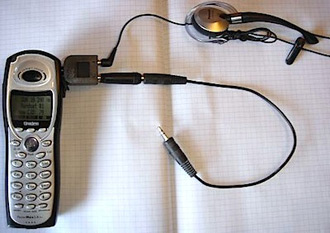
Hands-Free Phone-Interview Setup

headset-recording-sm.jpg

It's a serious issue in contemporary journalism: how do you record phone interviews while using a headset?

Radio Shack sells a nice, cheap device (the previously reviewed Mini-Phone Recorder) that interrupts the cord that goes from the handset to the phone, which works well when you're using the handset. But when I do interviews by phone, I like to type a rough transcript while I talk, and typing while clamping a handset to your ear with your shoulder can quickly get painful.

When I first confronted this problem earlier this year, I spent a lot of time on the internet looking for solutions. The ones I found were pretty unappetizing. The main technology on offer is a microphone that you stick in your ear, which seems both unpleasant and ineffective.

But then I encountered the good people at Sagebrush.com, who invented this elegant and inexpensive solution, which uses about $20 worth of stuff you can get from Radio Shack.

You need three items:

1. the Gold Series Y-Adapter, 3/32" Stereo Jacks & 3/32" Plug, which is item # 2264801 and costs $7;

2. a 1/8" Stereo Jack to 3/32" Stereo Plug Adapter, which is item # 2160379 and costs $6; and

3. a 12-Inch Shielded Stereo Audio Cable, which is item # 2265306 and costs $6.

The Y-Adapter splits the signal coming out of your phone's headset jack. One line goes to the headset; the other goes to the recorder.

Arguably, this is more of a hack than a Cool Tool. But it works (as long as your phone has a headset jack). And it's very portable: you can also use it on the road by plugging into a cell phone.

via kk.org

Posted via email from tellio's posterous

Thursday, August 12, 2010

Anthologize

Sometimes you run across a tool that you know will change your professional, personal, and pedagogical life. Anthologize, a new plug-in for WordPress, is one of these tools.

I have been experimenting with it all morning and although it is in alpha I find it to be in general working order. Anthologize is a result of the One Week One Tool initiative sponsored by Center for History and New Media (CHNM) at George Mason University. The idea was "more hack and less yack". In other words CHNM proposed  wanted "... a unique kind of institute: One Week, One Tool will teach participants how to build a digital tool for humanities scholarship by actually building a tool, from inception to launch, in a week—a digital humanities barn raising."

If you are interested here is some homework for you:

Read this overview of the tool and why it is so important.

Join this Zotero group if you want to keep apprised of links and resources.

Help out with work towards a beta version here.

Or check out a first rough attempt at using Anthology and exporting the output to Scribd as a pdf.


http://anthologize.org/

Tuesday, August 10, 2010

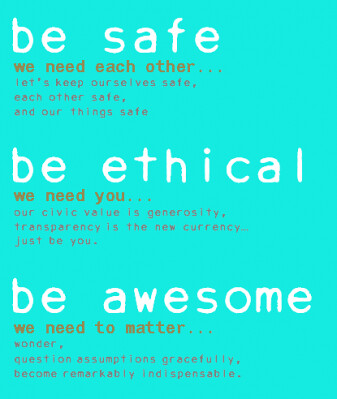
Be Safe, Be Ethical, Be Awesome


I just made “be safe, be ethical, be awesome” as my desktop background.
Sweet. I have been working to get schools to adopt at the very minimum
some sane social networking policies, but always in the background I am
wondering, “Is any of this really necessary?” Probably not in sane
systems. Isn’t the fact that we ‘need’ dress codes and AUP’s indicative
of a systemic illness or at least a failure of scale? Thanks for the
great image monika and thanks for sharing them.

Monday, August 09, 2010

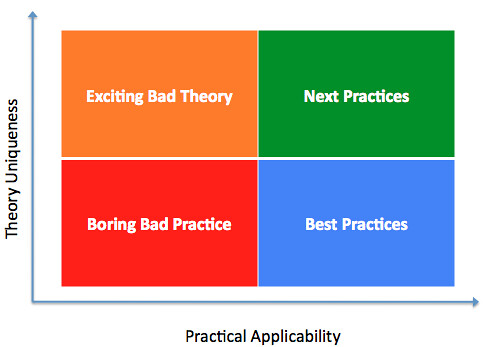
"Next Practices” or "How Curiosity Actually Saves the Cat"


I love finding useful, thought-provoking and oddly congruent ideas from other disciplines. I have thoroughly enjoyed reading Wikibon lately and this post's graph is a good example. I have always railed against the notion of a generalized 'best practice' because it is so contrary to complex and diverse systems like classrooms. You may have your own best practice, but only if it is customized to you.  But I do like the idea of 'next practice' . We should be wandering about inside and outside our disciplines foraging for not just the new new thang, but the idea or practice that is both practical and unique. In other words it must be both do-able as well as be appealingly fresh to our brains. If it is practical then we won't reject it out of hand and if it is unique, then it sets off all kinds of interesting and happy chemical cascades in our brains.

I use my social bookmarking tools, Diigo especially, to find these handy and 'deviant' tools. (Deviant in the statistical sense of standard deviance.) Here are a couple of qualifying samples of  the unique and practical.

Productivity guru, Mark Forster, has developed a method for getting stuff done that he calls Autofocus .  I am considering giving this tool a whirl, but the little piece of deviance I have found is in a reference to an animation created by Andreas Hoffman that demonstrates how the technique is done.  When you click on the 'animation' you download a pdf.  When I first opened it I thought Forster had the link wrong, but then you notice that the pdf has over 600 pages.  Hoffman has used each pdf page like an animation cell.  This is certainly a deviant use for pdf, but one that is unique and practical.  Are there other uses for this 'animation style'?  Could I combine this pdf with a screencast?  Acrobat has an automatic scroll function so you could start your screencast and then autoscroll.  I am sure others can come up with something sweeter and better with a little thought, but this a prime example of a deviant use that is completely handy.

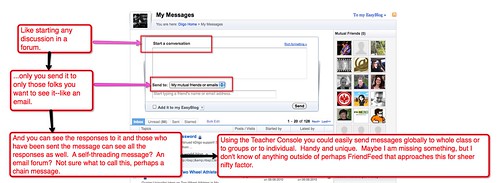
Another example is the messaging/threading function I have just discovered in Diigo.  Below is a screenshot from my account with annotations:

Annotated image of diigo messaging system

Like I wrote in my annotation, I don't use anything like this anywhere in my toolkit. I think it is very practical for the classroom in light of the very safe, secure, and social "Teacher Console" within Diigo for K-12. In higher ed it encourages social connection inside and out of the classroom as well as legitimizing right click research for students. This is the first tool I teach my students each semester and with this new messaging system, it, like the rug in "The Big Lebowski", really ties the 'room' together, dude.

Last, I am always looking for new presentation tools and styles for my students.  I have adopted the pecha kucha for the last couple of years for its sheer fun and effectiveness.  Students love it, too.  Although this style doesn't lend itself to improvisation (which I am very attracted to in my own teaching) I have recently discovered a way to combine two familiar tools into one that could be instructive and fun in the classroom.  It is called "Battledecks" and can best be described as powerpoint karaoke.  Below is a rather profane video of Anil Dash putting battledecks through its paces.


Will I use this in my composition class this year? It is fondly to be hoped. Perhaps after we research a particular topic and write a paper I will put together a battledeck or two or ten based on that topic and see where my students take it. This means that I will have to practice battledecking myself. I find that tools owned are tools shared.

My larger point here is that we need to have our internal radar up as we free range for new stuff to integrate into our classrooms. All you need to do is to stick out those antennae that sense what piques you. It is a capacity we all have, but sometimes we don't allow it to come out and play. The affordances it offers are staggering. You never know what glorious fun will come from a spin of that wheel, but I guarantee it will be interesting especially if you offer your students the same opportunity.

Thursday, August 05, 2010

Get Outside Your Echo Chamber

Cauliflower fractals...

Kevin Kelly -- KK* Lifestream
"In the network economy, nine times out of ten, your  fiercest competitor will not come from your own field. In turbulent  times, when little is locked in, it is imperative to search as wide as  possible for places where innovations erupt. Innovations increasingly  intersect from other domains. A ceaseless blanket search--wide, easy,  and shallow--is the only way you can be sure you will not be surprised.  Don't read trade magazines in your field; scan the magazines of other  trades. Talk to anthropologists, poets, historians, artists,  philosophers. Hire some 17-year-olds to work in your office. Make a  habit to visit a web site at random. Tune in to talk radio. Take a class  in scenario making. You'll have a much better chance at recognizing the  emergence of something important if you treat these remote venues as  neighbors."

Reading Kevin Kelly's admonition to cast a wider net into other  disciplines comes from the simple observation that many innovations come  from outside one's own field.  Revolutions rarely come from within.  In  that spirit I would like to request that others write a little about  the outside sources that jostle the status quo within education either  intentionally or by accident.

Here are a few sites I recommend to get you out of your edublogging echo chamber:

1. One of my favorites is Kevin Kelly and Gary Wolf's The Quantified Self.  Any look at recent posts will inspire you to think about your own discipline.

* For example, why can't classes be more like Meet-Ups?   Some of my most successful classes were ones where we met socially for  breakfast or coffee/tea.  Why not have a Meet-Up Monday?
* What about observing our disciplines and student use of tools within the discipline? A recent post about Bill Jarrold describes  how he uses the command line to log productivity.  Why not use Twitter  and Twitter hashtags to "log" writing productivity of all sorts that  your students produce?  I teach composition and have wondered about my  students' writing lives.  This would be a good way to open up a can of  observation on 'em.
* What about foursquare to extend the boundaries of your classroom?  I  have been wondering about how to bring games into the classroom and this  might be it.  What are the affordances of foursquare in the classroom? This post suggests a data visualization for it and some more ideas.  Yes, I think this will do.

2. Another one is ze frank's page:

* I love how the effectiveness of the blog-comment template is shown so well here.   It is a pattern that any writer can use to attract an audience.   Besides it demonstrates one of ze frank's principles so well--surprise  is everywhere.

3.  Or Dave Snowden's excellent and evocative Cognitive Edge.  While technically inside of the envelope of learning and education he also writes about leadership and family.

* Snowden's software, SenseMaker Suite, might be applicable to my burgeoning dissertation interest in social capital in professional learning communities.
* Or perhaps you discover a quote that thoroughly bumfuzzles your mind  like this one:  "In general, if a community is not physically,  temporally and spiritually rooted, then it is alienated from its  environment and will focus on survival rather than creativity and  collaboration."  This may seem obvious to many, but to me it points to  the sterility of classrooms in general and to mine in paricular.  One of  the oddest feelings I have gotten since I moved from teaching high  school to university has been a 'coldness'.  I miss the heat of high  school and I think this quote explains this in part and points me toward  a major goal for fall classes--figure out ways to root my classes.  And  I also think about how to 'root' my online classes as well.

4.  How about Scott McCloud's Mind Dump where I discovered:

* Eric Mazur's physics class where  he  makes the awesomely sensible and arguable assertion that you can  forget facts but you can't forget understanding.  This guy is my new  hero and I am determined to apply some of his techniques for physics to  my lit and comp classes.
* Or perhaps I will be moved to print up this quote from Seth Godin that McCloud points to for  our consideration:  "The internet has dramatically widened the number  of available substitutes. You don't have to like it, but it's true. That  means you have to work far harder to create work that can't easily be  replaced."  How can I make myself less replaceable?  That is an  essential question for every world class employee who wants real job  security.

How about the blog Sports Are 80% Mental ?

* File this under the category "Everything You Know Is Wrong":   "Physical activity had no impact on weight change, but weight clearly  led to less activity."  In other words don't be hatin' on the fat man or  boy or woman or girl.  My second thought when I read this was whether  there are similar 'Truths' in my discipline that need puncturing. What  are the assumptions that guide my work that might be wrong?  I will be  on my guard for this during the upcoming school year and will report  back.

The idea that innovation comes from the margins seems right  biologically-- growth occurs along the edge (wherever that might be). So  my challenge to you is to bring back similar (and better) missives from  the fraxillated margins.  Just fold one interest right on top of  another and that's where you might want to be.
Enhanced by Zemanta

Tuesday, August 03, 2010

Podcasting for Kids

This is good information on how to do a podcast, how to integrate it into what teachers do, and how to justify it.  I can see how valuable this might be as a solid first step toward a larger goal.  And what would that large goal be?  To show kids how to get inside their heads and find the stuff they are passionate about and then use the tool to convey that passion.  At their age they need just enough skill to balloon their personal joys into the air. 


Posted via email from tellio's posterous

Quel Difference!

Wow, Alan Kay explains what a difference an "s" makes in our understanding of the world.

Posted from Diigo. The rest of my favorite links are here.

Friday, July 30, 2010

Academic Productivity » The Future of the Journal, by Anita de Waard

This advice for researchers is apt for ANY writer at work from now on end.


Posted from Diigo. The rest of my favorite links are here.

Sunday, July 18, 2010

Sunday, June 20, 2010

Unboxed - Yes, People Still Read, but Now It’s Social - NYTimes.com

  • tags: no_tag

    • “THE point of books is to combat loneliness,” David Foster Wallace observes near the beginning of “Although of Course You End Up Becoming Yourself,” David Lipsky’s recently published, book-length interview with him.
    • other readers have highlighted the passage on their Kindles, making it one of the more “popular” passages in the book.


    • Thanks to e-mail, Twitter and the blogosphere, I regularly exchange information with hundreds of people in a single day: scheduling meetings, sharing political gossip, trading edits on a book chapter, planning a family vacation, reading tech punditry. How many of those exchanges could happen were I limited exclusively to the technologies of the phone, the post office and the face-to-face meeting? I suspect that the number would be a small fraction of my current rate.
    • high-level thinking when the culture migrates from the page to the screen.
    • Mr. Carr’s original essay, published in The Atlantic — along with Clay Shirky’s more optimistic account, which led to the book “Cognitive Surplus”
    • The intellectual tools for assessing the media, once the province of academics and professional critics, are now far more accessible to the masses.
    • The question is not whether our brains are being changed. (Of course new experiences change your brain — that’s what experience is, on some basic level.) The question is whether the rewards of the change are worth the liabilities.
    • Quiet contemplation has led to its fair share of important thoughts. But it cannot be denied that good ideas also emerge in networks.

Posted from Diigo. The rest of my favorite links are here.

Saturday, June 19, 2010

Authentic Learning Group Diigo (weekly)


Posted from Diigo. The rest of Authentic Learning group favorite links are here.

Friday, May 21, 2010

Skype Keeps on Getting Better


Image via CrunchBase
Download the beta version of Skype for Windows


I have been enamored of Skype for as long as it has been around.  It is one of those tools like etherpad, diigo, and zotero that just works.  It is the one tool that I recommend all teachers become friends with because it is a gateway to long distance sharing and learning with others.  Now Skype has five-way video conferencing.  And as David Gurteen points out it has screensharing as well for both Windows and Mac.  Here are some more 'hidden' features:

Forward your calls for free to another
Skype name, e.g. from your home PC to your work PC.

Use Skype and IM-chat simultaneously--redundancy is good.
Emoticons add-on.  And how to add them to Mac.
A directory of plug-ins.
Use it as an answering maching or a lie detector.
Or just read this very clear and useful post.


Reblog this post [with Zemanta]

Thursday, May 20, 2010

Bionic Teaching
Education is failing.
Our solution is not to work, to spend money and time on our teachers, to help them become better, instead we send our money away, spending precious time testing products of a system we insist is broken.
We buy software. We buy content. We buy external experts.2 We buy reputation. We buy “trust” and “quality” because we don’t believe either really exists in our schools.
Invest that money in our teachers, on smaller classes, on things that have been proven to matter.
Make teaching a career that isn’t based on martyrdom. Martyrs die flaming deaths. Systems based on them don’t last. There are no easy answers. You can’t buy, process, software, magic your way out of this.
There is no microwave dinner version of educational reform.


Lots of very strong sound bites.  I suspect that the writer would agree that we have had a problem with the experts being on top and not on tap.

Monday, May 17, 2010

Twitter: Gateway to Teaching Professionalism


Image via Wikipedia
Educational Hash Tags  

Many of us started demonstrating Twitter without a thought as to its practicability.  I know I did.  I recalled showing it to a group of teachers in a summer writing academy almost three years ago to the deafening yawn of....meh.  I knew it was a big wave building, but had no idea how its complex iterations would flood my own professional life.  Now?  If I want to get my 'regular' work done I better not open up TweetDeck.  Just this morning I followed the #wisdom2conf hashtag to a fabulous TEDxTokyo talk by Dr. Hiroshi Tasaka on Invisible Capitalism  and from there to Umair Hacque on Behavioural Innovation and from that to RSA Animate's glorious animations including Jeremy Rifkin's The Empathic Civilisation.  The biochemical high from scratching the itch of the curious is my mostly positive addiction especially when combined with its necessary consequent--sharing.  I guess that is why I conflate teaching and learning to the point where I am so overcome by my good fortune that I occasionally turn to my class with a conspiratorial whisper and say, "They pay me to learn!" 

One of my goals this summer is to get my twitter professional development on track and to help others do the same.  This means taking in another river of information.  I can hear you saying good luck with that to which I respond with a hearty, "Thank you.  Any help you might lend in this OED-ian task would be gratefully acknowledged with words but no money."  The educational hashtags link above is a good place for me to start sharing a little bit more deeply with the Twitter community what I am raking in.  It is time for me to innovate my own behavior, to disrupt my own personal learning algorithm, and to extend an empathic toe into my professions water in preparation for leap into the shallow end.  At least I think it is the shallow end. 


Reblog this post [with Zemanta]

Thursday, April 29, 2010

Google Voice and RubrickJetpack Mashup?

From Fish to Infinity

Reading a new opinion columnist in the NYT—Stanley Strogatz.  His column is called “From Fish to Infinity” (which I can only guess is a paean to cosmologist George Gamow's One, Two, Three...Infinity) and explores what he calls a second chance at math.  It is a new way (to me anyway) for subjects to be explored in the Times because it takes a slightly more academic bent in its treatment of sources.  It cites them. Who knew?  That is a ‘new’ model.  Better yet it has introduced me to a book and an article that I might never have seen as a math lover from afar. 

  1. “E. Wigner, “The unreasonable effectiveness of mathematics in the natural sciences,” Communications in Pure and Applied Mathematics, vol. 13, No. I (February 1960), pp. 1-14. A pdf version is here.  I put this one in my iPod touch and use the app, Papers, to read it.  My skim of it can only come up with one word--mordant.
  2. P. Lockhart, “A Mathematician’s Lament: How School Cheats Us Out of Our Most Fascinating and Imaginative Art Form” (Bellevue Literary Press, 2009).   This one goes on my wishlist at Amazon.  Please, anyone feeling generous?  Otherwise I will have to get it via Interlibrary Loan (which the Firefox extension Book Burro found for me quite handily).
I have laid the breadcrumbs out.  They are tasty and lead to a gingerbread house of an article.  I look forward to following and commenting on his entire series.


Google Voice Embeds

Saturday, April 03, 2010

Authentic Learning Group Diigo (weekly)


Posted from Diigo. The rest of Authentic Learning group favorite links are here.

Thursday, February 11, 2010

YouTube Doubler at bavatuesdays/Touchstone for Other Class Uses

YouTube Doubler at bavatuesdays

"Could see that being a very effective way for thinking through video editing, which is a series of important choices that one learns through both practice and example—and one needs to learn right away that cutting and editing have become synonymous for a reason—you must cut, cut, and then cut your shots again. "
 This could also be a lesson to writers as well. Kill yer babies. Clip back the flush of verbiage. I can also see it as a way to promote creative presentation ideas in the classroom.  And a simple but fun collaborative project to get students to work together.


Wednesday, February 10, 2010

EBSCOhost: EYE ON RESEARCH: 'Value Added' Gauge of Teaching Probed

  • tags: no_tag

    • "value added" methods
    • value-added assessments
    • a "falsification" test
    • For example, he asked, what effect do 5th grade teachers have on their students' test scores in 3rd and 4th grades?
    • Because it's impossible for even the best teachers to have an impact on students' previous learning, Mr. Rothstein reasons, there should be no impact.
    • value-added calculations are based on the assumption that students' classroom assignments are random,
    • teachers' long-run effects on individual students and finds that they tend to decay or fade out after the first year.
    • The study also found, as Mr. Rothstein did, that the teacher effects faded in their students' performance from one year to the next, which may be the more important issue, according to Mr. Staiger.

      "When calculating the potential value of shifting the teacher-effectiveness distribution, we and others have typically assumed that the effects of a strong teacher persist in the children they teach," write Mr. Staiger and Mr. Kane, who is the faculty director of the Seattle-based Bill & Melinda Gates Foundation's project on policy innovation.

    • We still have the reliability problem,

Posted from Diigo. The rest of my favorite links are here.

Saturday, January 16, 2010

Authentic Learning Group Diigo (weekly)


Posted from Diigo. The rest of Authentic Learning group favorite links are here.

Friday, January 08, 2010

Picture time

Pix

Posted via email from tellio's posterous

10 Ways To Learn In 2010: The eLearnin...

Posted via email from tellio's posterous

10 Ways To Learn In 2010: The eLearnin...

Posted via email from tellio's posterous

REdefining Work Context

Work context? Why not the art of defining knowledge and skill requirements? After all, we are talking about learning here, and training is obviously a part of that, right? Certainly, it is…and that is exactly the point of this writing – training is indeed a part of learning – and in some cases, only a very small part. Josh Bersin of Bersin & Associates referenced in July 2009 on the “The Future of the Business of Learning” webinar that training organizations spend upwards of 80% of their time and resources focused on formal training activities. He also noted that there was a dramatic increase in the use of informal learning. Training organizations will not keep pace with that trend unless their discovery efforts include the work context where informal learning opportunities surface.

Posted via email from tellio's posterous